Role
Senior Product Designer
Leading UX for a global Fortune 10 enterprise authoring platform that supports end‑to‑end content creation, localization, security, review, and publishing workflows. Partnered closely with Product, Engineering, and global content operation stakeholders to define product direction, architect critical workflows (authoring, taxonomy, governance, and change tracking), and deliver a robust, scalable, trustworthy platform for teams worldwide. Used AI tools as a thinking partner to stress-test workflows, surface edge cases, and translate ambiguous stakeholder input into clear interaction models before committing to design and engineering effort.
Due to confidentiality, this page focuses on the product challenges, systems thinking, and platform outcomes rather than exposing internal workflows, interfaces, or business-sensitive details. Additional context and selected visuals are available in private conversations.
Method
workflow design, UX research, system architecture, service design, user journeys, user flows, editor interactions, dashboard design, governance models, localization workflows, security frameworks, design systems, and end-to-end product delivery, and AI-augmented discovery and systems thinking (using ChatGPT, Claude, and Perplexity to model personas, failure states, interaction logic and test accessibility).
Senior Product Designer
Leading UX for a global Fortune 10 enterprise authoring platform that supports end‑to‑end content creation, localization, security, review, and publishing workflows. Partnered closely with Product, Engineering, and global content operation stakeholders to define product direction, architect critical workflows (authoring, taxonomy, governance, and change tracking), and deliver a robust, scalable, trustworthy platform for teams worldwide. Used AI tools as a thinking partner to stress-test workflows, surface edge cases, and translate ambiguous stakeholder input into clear interaction models before committing to design and engineering effort.
Due to confidentiality, this page focuses on the product challenges, systems thinking, and platform outcomes rather than exposing internal workflows, interfaces, or business-sensitive details. Additional context and selected visuals are available in private conversations.
Method
workflow design, UX research, system architecture, service design, user journeys, user flows, editor interactions, dashboard design, governance models, localization workflows, security frameworks, design systems, and end-to-end product delivery, and AI-augmented discovery and systems thinking (using ChatGPT, Claude, and Perplexity to model personas, failure states, interaction logic and test accessibility).
Duration
4.5‑year engagement, from early platform evolution through multiple strategic initiatives across authoring, taxonomy, governance, and publishing workflows.
4.5‑year engagement, from early platform evolution through multiple strategic initiatives across authoring, taxonomy, governance, and publishing workflows.
Expertise
• Product & platform strategy: Defined the role of the enterprise authoring platform content operations, clarifying how it should support global teams, governance needs, and long‑term scalability.
• Systems and service design: Mapped end‑to‑end content journeys (authoring, localization, review, publishing) and redesigned workflows so distributed teams could work in a single, coherent system.
• AI-enabled design practice: Applied conversational AI as a rapid synthesis layer to explore edge cases, simulate author/reviewer/governance personas, and pressure-test complex workflows before research and engineering investment.
• Interaction and behavior models: Established core patterns for structured authoring, conditions, variables, and change tracking; why, and what changed and required action across hundreds of topics.
• Governance, security, and trust: Designed governance and access patterns—including secure workflows, disclosure‑based access, and failure/edge‑state behaviors—that made sensitive content feel safe and predictable
• Content structure and taxonomy: Re‑architected taxonomy and targeting logic to separate authoring from taxonomy management, enabling reusable condition rules across audiences, regions, and devices.
• Visibility and operational clarity: Created dashboards and feedback mechanisms that surfaced readiness, unpublished changes, and workflow health earlier in the process, reducing review churn and publish‑blocking
• Design systems and collaboration: Developed reusable interaction patterns, editor components, and platform conventions that engineering and content teams could extend
• Product & platform strategy: Defined the role of the enterprise authoring platform content operations, clarifying how it should support global teams, governance needs, and long‑term scalability.
• Systems and service design: Mapped end‑to‑end content journeys (authoring, localization, review, publishing) and redesigned workflows so distributed teams could work in a single, coherent system.
• AI-enabled design practice: Applied conversational AI as a rapid synthesis layer to explore edge cases, simulate author/reviewer/governance personas, and pressure-test complex workflows before research and engineering investment.
• Interaction and behavior models: Established core patterns for structured authoring, conditions, variables, and change tracking; why, and what changed and required action across hundreds of topics.
• Governance, security, and trust: Designed governance and access patterns—including secure workflows, disclosure‑based access, and failure/edge‑state behaviors—that made sensitive content feel safe and predictable
• Content structure and taxonomy: Re‑architected taxonomy and targeting logic to separate authoring from taxonomy management, enabling reusable condition rules across audiences, regions, and devices.
• Visibility and operational clarity: Created dashboards and feedback mechanisms that surfaced readiness, unpublished changes, and workflow health earlier in the process, reducing review churn and publish‑blocking
• Design systems and collaboration: Developed reusable interaction patterns, editor components, and platform conventions that engineering and content teams could extend
Observable Outcome:
• Launched CMS platform adopted by every Apple technical writer
Played an integral role designing the authoring workflows and system foundations that helped the platform reach 100% adoption across Apple technical writers.
• Unified fragmented content operations
Helped transform separate authoring, localization, review, and publishing workflows into a more cohesive platform experience.
• Launched CMS platform adopted by every Apple technical writer
Played an integral role designing the authoring workflows and system foundations that helped the platform reach 100% adoption across Apple technical writers.
• Unified fragmented content operations
Helped transform separate authoring, localization, review, and publishing workflows into a more cohesive platform experience.
• Clarified complex information architecture
Separated concepts like taxonomy, variables, conditions, approvals, and publishing readiness so teams could understand and act on them more confidently.
Separated concepts like taxonomy, variables, conditions, approvals, and publishing readiness so teams could understand and act on them more confidently.
• Designed systems, not just screens
Created reusable patterns, lifecycle models, and interaction rules that supported multiple workflows across the platform.
Created reusable patterns, lifecycle models, and interaction rules that supported multiple workflows across the platform.
• Improved cross-functional alignment
Used design artifacts, workflow models, and service design thinking to align product, engineering, content operations, and reviewer needs.
Used design artifacts, workflow models, and service design thinking to align product, engineering, content operations, and reviewer needs.
• Made system state more visible
Designed experiences that showed what was draft, blocked, ready, finalized, approved, or published so teams could move with fewer surprises.
Designed experiences that showed what was draft, blocked, ready, finalized, approved, or published so teams could move with fewer surprises.
• Built foundations for scale
Created durable UX patterns that could support new content types, markets, governance needs, and operational complexity over time.
Created durable UX patterns that could support new content types, markets, governance needs, and operational complexity over time.
Case Studies
Visually detailed case studies for key initiatives are below:
Visually detailed case studies for key initiatives are below:
Key Platform Initiatives
Conditions Management Platform · Codename Variables System · Change Tracking/Diff Comparison · Secure Topics · Topic Properties · Workflow Wizard · Localization Workflows · Authoring Infrastructure · Publishing & Summary Dashboards
Conditions Management Platform · Codename Variables System · Change Tracking/Diff Comparison · Secure Topics · Topic Properties · Workflow Wizard · Localization Workflows · Authoring Infrastructure · Publishing & Summary Dashboards
Designing for Complexity at Scale
I designed end-to-end authoring experiences that allow content creators to manage localization, metadata, and structure without breaking flow. This included introducing core editor capabilities—such as structured content components, inline media, and content measurement tools—to help teams scale content with consistency and precision.
I designed end-to-end authoring experiences that allow content creators to manage localization, metadata, and structure without breaking flow. This included introducing core editor capabilities—such as structured content components, inline media, and content measurement tools—to help teams scale content with consistency and precision.
A key focus was improving how writers developed topics, moved projects through workflow, and how reviewers approve content. I led the design of many foundational systems, enabling teams to clearly see what stage content is at; what edits have been made and what requires validation—reducing friction in high-volume publishing environments. Throughout this work, I used AI tools to generate alternative diff and review flows, compare system behaviors across edge cases, and refine UX-writing for labels, guidance, and error states in dense enterprise interfaces.
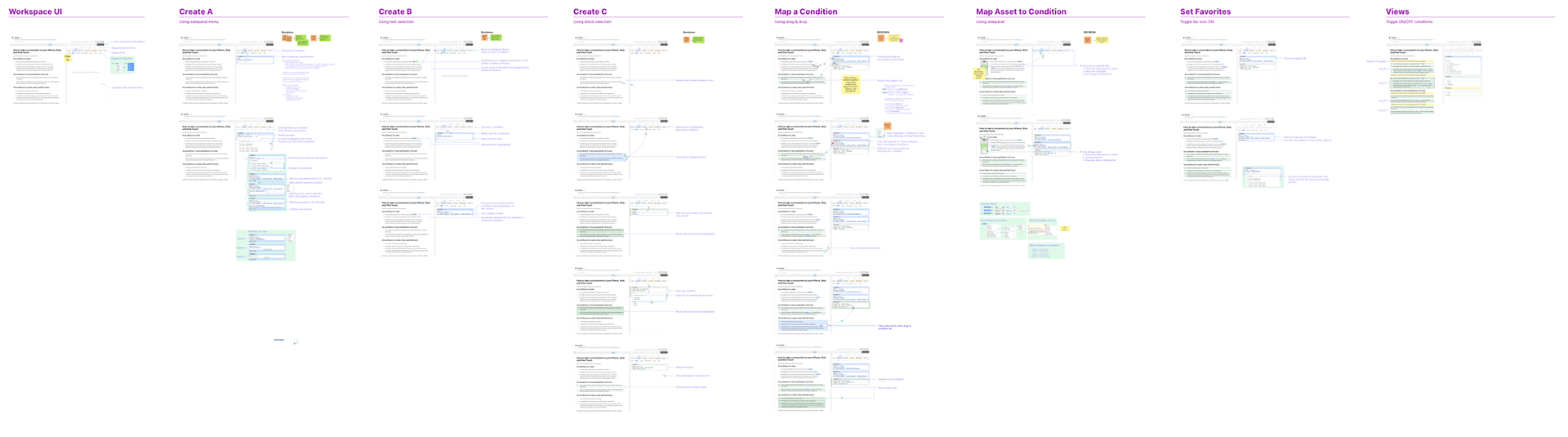
Iterative design and whiteboard collaboration process
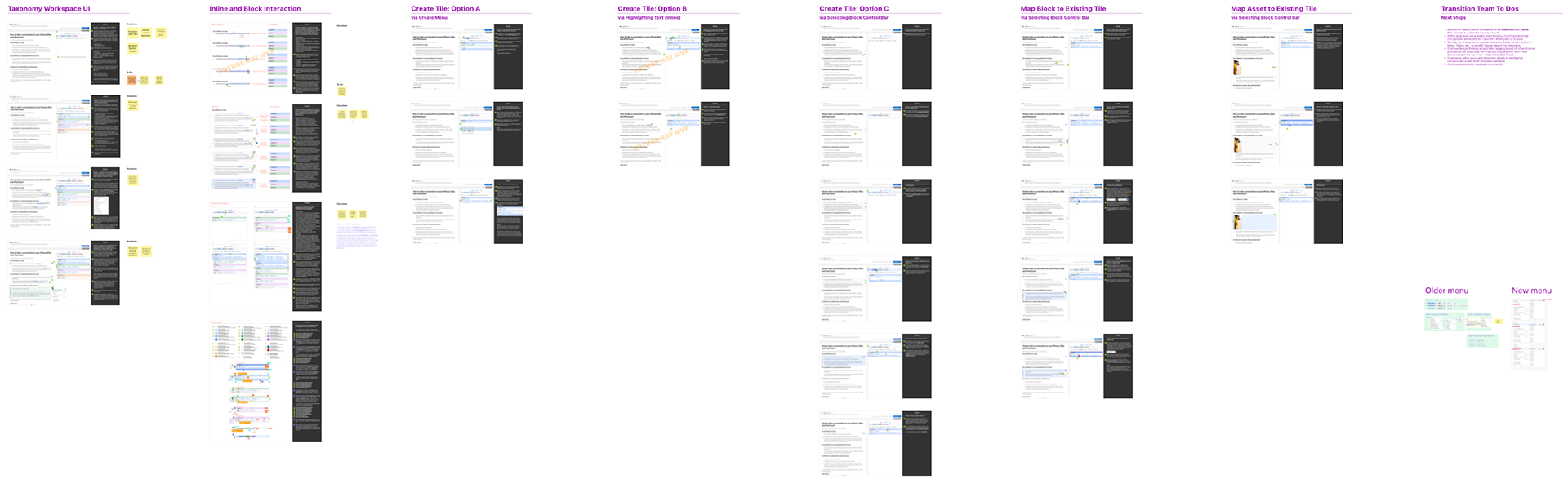
Refined designs with detailed annotations for hand off to engineering
Governance, Security, and System Behavior
To support sensitive and regulated content, I designed systems that balance strict governance with usability. This included defining secure content workflows, disclosure-based access, and clear patterns for handling broken or restricted states—ensuring users always understand what’s happening and how to resolve issues. I relied on AI to help enumerate governance and security failure modes, organize complex rule sets, and compare competing resolution flows so that final decisions reflected human judgment, regulatory constraints, and domain expertise.
To support sensitive and regulated content, I designed systems that balance strict governance with usability. This included defining secure content workflows, disclosure-based access, and clear patterns for handling broken or restricted states—ensuring users always understand what’s happening and how to resolve issues. I relied on AI to help enumerate governance and security failure modes, organize complex rule sets, and compare competing resolution flows so that final decisions reflected human judgment, regulatory constraints, and domain expertise.
I also led the design of a Codename Variables system, creating a scalable “single source of truth” for dynamic secure content. This system addressed challenges around naming secrecy, consistency, localization, and validation, introducing lifecycle states, preflight checks, and resolution workflows that operate across hundreds of topics.

Platform interface intentionally obscured due to confidentiality
Conditions Management – Scaling Structure Through Taxonomy
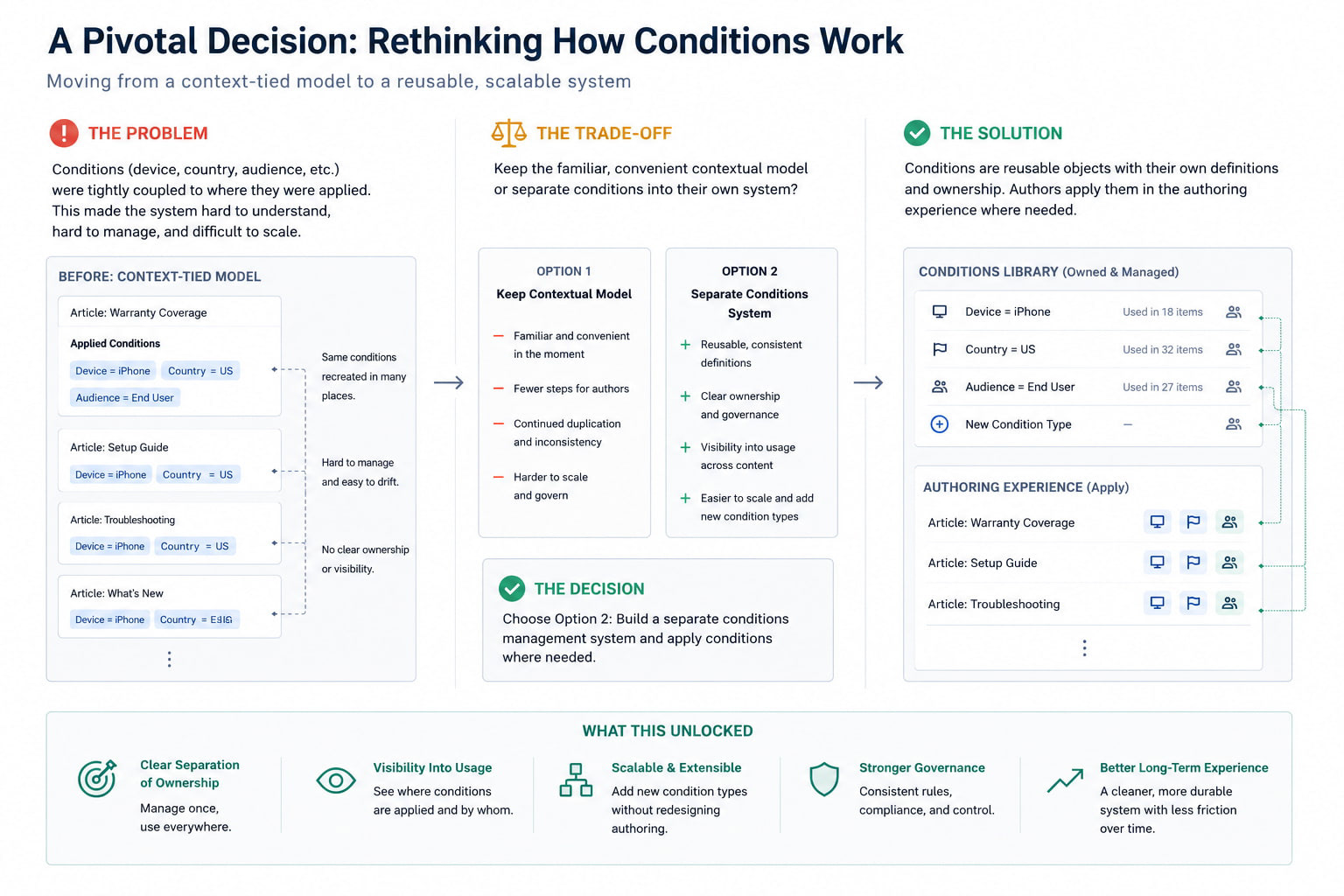
A major initiative focused on re-architecting a fragmented taxonomy system into a scalable platform called Conditions Management. I defined a clear separation between authoring and taxonomy management, enabling reusable condition logic across audience, region, and device targeting.
A major initiative focused on re-architecting a fragmented taxonomy system into a scalable platform called Conditions Management. I defined a clear separation between authoring and taxonomy management, enabling reusable condition logic across audience, region, and device targeting.
To tame the complexity, I ran concept workshops with product and engineering, explored four competing models, and drove alignment around a dedicated Taxonomy Workspace that separates writing from rule management while keeping every active condition, view state, and targeting relationship visible and auditable. I used AI tools to quickly prototype and critique alternative taxonomy and targeting models, revealing edge-case targeting conflicts and helping teams converge faster on a coherent Conditions Management strategy.
I partnered closely with writers, content strategists, and engineers to translate research pain points into concrete interaction patterns—multi-path creation flows, drag-and-drop targeting, keyboard shortcuts, and a fully annotated spec set—so the system could handle overlapping inline and block conditions without overwhelming authors or introducing implementation ambiguity.
I partnered closely with writers, content strategists, and engineers to translate research pain points into concrete interaction patterns—multi-path creation flows, drag-and-drop targeting, keyboard shortcuts, and a fully annotated spec set—so the system could handle overlapping inline and block conditions without overwhelming authors or introducing implementation ambiguity.
This work established consistent interaction patterns, improved discoverability, and reduced redundancy—laying the foundation for long-term scalability across content systems. I reframed conditions from ad-hoc inline tags into reusable, tile-based rule objects that could target text, blocks, and assets across 190+ regions and multiple taxonomies (conditions, countries, audiences, A/B tests).
Observable Outcomes:
• Created a reusable conditions model
Moved conditions from one-off, context-bound rules into reusable objects with clearer ownership, definitions, and application points.
Moved conditions from one-off, context-bound rules into reusable objects with clearer ownership, definitions, and application points.
• Reduced duplication across authoring workflows
Gave teams a way to define conditions once and apply them consistently across content, instead of recreating the same logic in multiple places.
Gave teams a way to define conditions once and apply them consistently across content, instead of recreating the same logic in multiple places.
• Made condition usage visible
Helped authors and operations teams understand where conditions were applied, who owned them, and how changes could affect downstream content.
Helped authors and operations teams understand where conditions were applied, who owned them, and how changes could affect downstream content.
• Improved governance without adding unnecessary author burden
Balanced flexibility with control by separating condition management from everyday authoring while keeping application simple.
Balanced flexibility with control by separating condition management from everyday authoring while keeping application simple.
• Created a scalable foundation for future condition types
Designed the system so new condition categories could be added without redesigning the authoring experience each time.
Designed the system so new condition categories could be added without redesigning the authoring experience each time.
Codename Variables – Secure Text at Scale
I led the design of Codename Variables, transforming fragile search‑and‑replace workflows into centrally managed, secure text objects for technical writers. I reframed the problem around “author once, reuse safely,” enabling writers to manage codenames, product names, versions, and dates as first‑class entities with disclosure‑based access controls and publish‑time safeguards.
I led the design of Codename Variables, transforming fragile search‑and‑replace workflows into centrally managed, secure text objects for technical writers. I reframed the problem around “author once, reuse safely,” enabling writers to manage codenames, product names, versions, and dates as first‑class entities with disclosure‑based access controls and publish‑time safeguards.
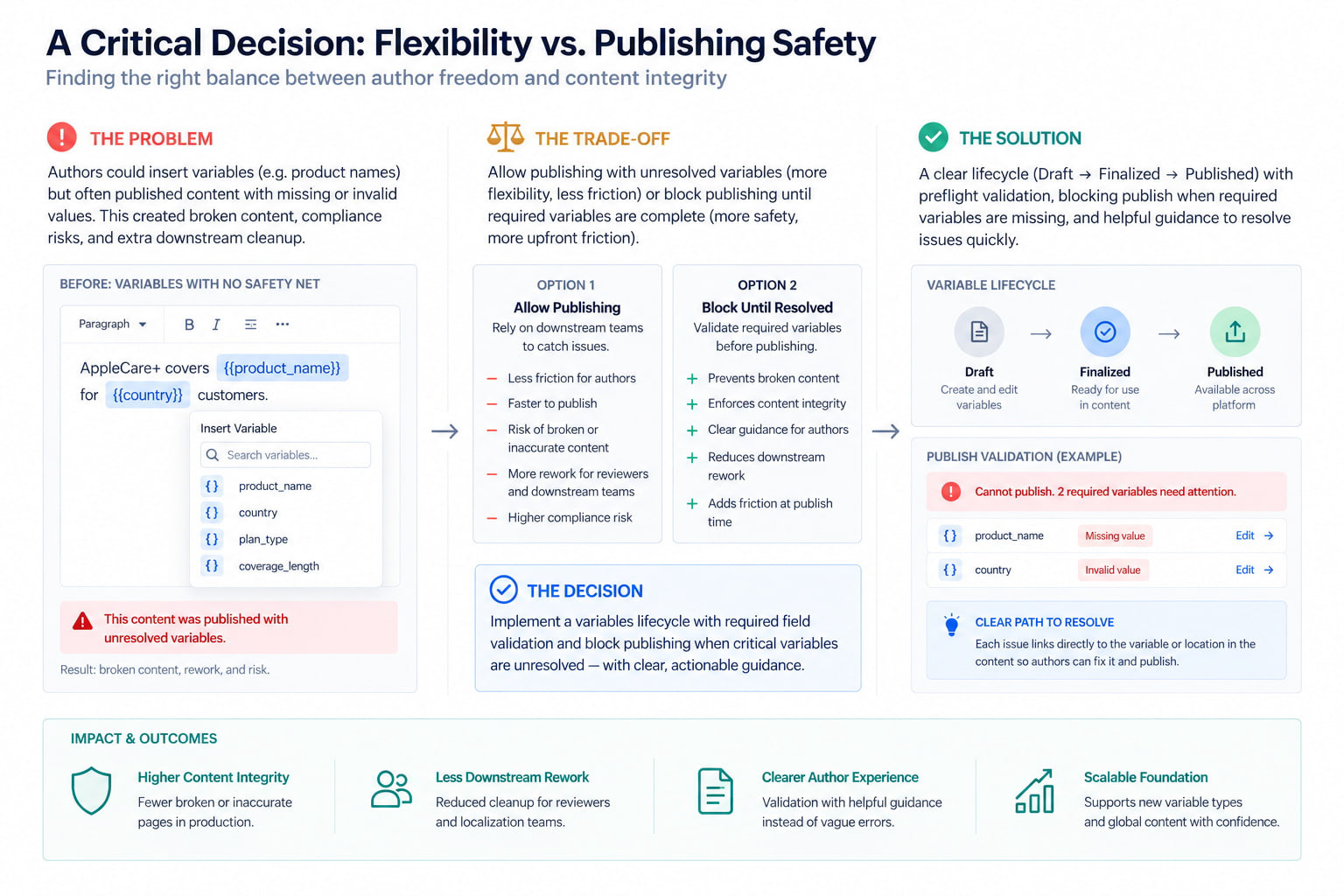
I defined the single‑finalize lifecycle and interaction model for variables, using inline pill‑based indicators to distinguish them from conditions and notes while enforcing hard publish‑blocking when "unfinalized" or classified text remained. I also evolved system language and IA, replacing “Break Relationship” with “Convert to Text” to better match writer mental models and reduce hesitation around irreversible actions. AI supported this work by exploring multiple naming, state, and messaging variants for variables, ensuring writers could clearly distinguish secure text objects from conditions and notes under real-world pressure.
Beyond authoring, I extended variables into governance by integrating their history into the existing Activity Dashboard rather than adding a new surface, creating a unified audit trail across topics. Mapping secure variable handling to the existing Disclosure ID model allowed writers to adopt new security capabilities without learning a new permission system.
This work eliminated manual search‑and‑replace for product updates, reduced launch‑day delays from inconsistent codename cleanup, and closed the risk of shipping live content with placeholder variables. It also established visual and behavioral standards for variables that now underpin future enhancements like multi‑version variables, reselect‑ready topics, snippets, and deeper localization integration.
Observable Outcomes:
Observable Outcomes:
• Introduced a safer variable lifecycle
Defined a clear progression from draft to finalized to published, helping teams understand when variables were ready to use in content.
Defined a clear progression from draft to finalized to published, helping teams understand when variables were ready to use in content.
• Prevented incomplete content from moving forward
Designed validation patterns that surfaced missing or invalid variables before publishing, reducing avoidable cleanup and downstream risk.
Designed validation patterns that surfaced missing or invalid variables before publishing, reducing avoidable cleanup and downstream risk.
• Made errors actionable for authors
Replaced vague publishing blockers with clear guidance that pointed authors to the specific variable or content location that needed attention.
Replaced vague publishing blockers with clear guidance that pointed authors to the specific variable or content location that needed attention.
• Balanced author flexibility with publishing safety
Preserved the ability to create and insert variables while adding guardrails where unresolved values could affect content integrity.
Preserved the ability to create and insert variables while adding guardrails where unresolved values could affect content integrity.
• Strengthened confidence in reusable content
Helped teams use variables across global content workflows with clearer expectations, fewer surprises, and more predictable publishing behavior.
Helped teams use variables across global content workflows with clearer expectations, fewer surprises, and more predictable publishing behavior.
Visibility, Feedback, and Operational Clarity
To improve system transparency, I designed dashboards and supporting tools that give teams real-time visibility into content status, readiness, and workflow health.
To improve system transparency, I designed dashboards and supporting tools that give teams real-time visibility into content status, readiness, and workflow health.
This included features that surface unpublished changes, highlight issues earlier in the process, and reduce back-and-forth during review cycles—helping teams move faster with greater confidence. I used AI to simulate reviewer and publisher journeys through these dashboards, testing how different roles interpreted states and alerts before committing to final interaction patterns.
Strategic Thinking
Beyond shipped features, I developed forward-looking concepts to evolve the platform, including system-wide notifications and enhanced change tracking experiences. These initiatives aligned product direction with business needs while maintaining a focus on usability and clarity.
Beyond shipped features, I developed forward-looking concepts to evolve the platform, including system-wide notifications and enhanced change tracking experiences. These initiatives aligned product direction with business needs while maintaining a focus on usability and clarity.
My Role at Huge as Apple Care Digital Designer
This work, alongside my other case studies, shows my ability to operate at a Senior level on complex enterprise platforms—shaping content operations, workflows, and governance systems while applying consistent principles of research‑driven UX, systems thinking, and design leadership.
This work, alongside my other case studies, shows my ability to operate at a Senior level on complex enterprise platforms—shaping content operations, workflows, and governance systems while applying consistent principles of research‑driven UX, systems thinking, and design leadership.
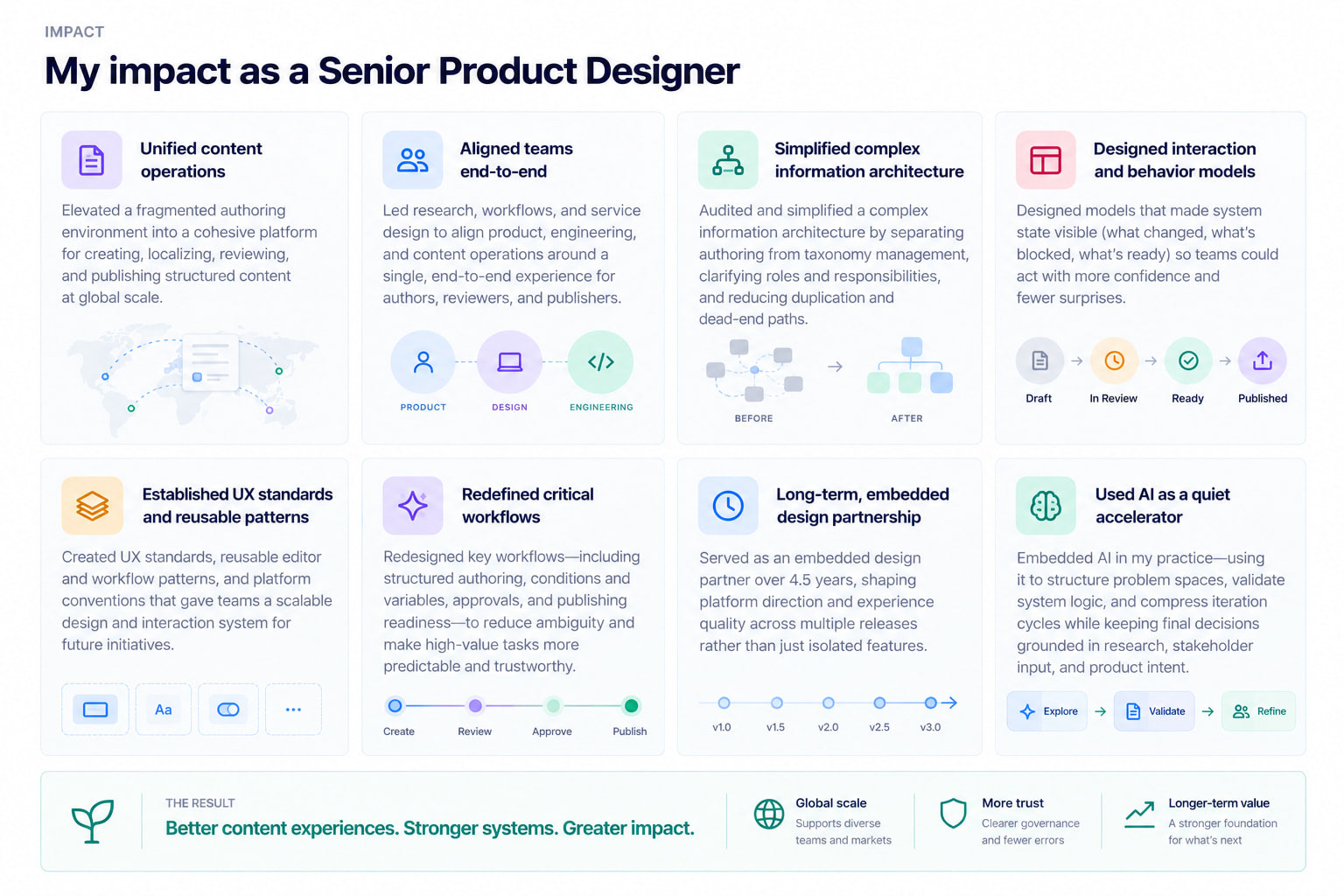
• Elevated a fragmented internal authoring environment into a more coherent enterprise platform for creating, localizing, reviewing, and publishing structured content at global scale.
• Led research, workflows, and service design to align product, engineering, and content operations around a single, end‑to‑end experience for authors, reviewers, and publishers.
• Audited and simplified a complex information architecture by separating authoring from taxonomy management, clarifying roles and responsibilities, and reducing duplication and dead‑end paths.
• Redefined critical workflows—including structured authoring, conditions and variables, approvals, and publishing readiness—to reduce ambiguity and make high‑value tasks more predictable and trustworthy.
• Led research, workflows, and service design to align product, engineering, and content operations around a single, end‑to‑end experience for authors, reviewers, and publishers.
• Audited and simplified a complex information architecture by separating authoring from taxonomy management, clarifying roles and responsibilities, and reducing duplication and dead‑end paths.
• Redefined critical workflows—including structured authoring, conditions and variables, approvals, and publishing readiness—to reduce ambiguity and make high‑value tasks more predictable and trustworthy.
• Designed interaction and behavior models that made system state visible (what changed, what’s blocked, what’s ready) so teams could act with more confidence and fewer surprises.
• Established UX standards, reusable editor and workflow patterns, and platform conventions that gave teams a scalable design and interaction system for future initiatives.
• Served as a long‑term, embedded design partner over 4.5 years, shaping platform direction and experience quality across multiple releases rather than just isolated features.
• Embedded AI as a quiet accelerator in my practice—using it to structure problem spaces, validate system logic, and compress iteration cycles while keeping final decisions grounded in research, stakeholder input, and product intent.
• Established UX standards, reusable editor and workflow patterns, and platform conventions that gave teams a scalable design and interaction system for future initiatives.
• Served as a long‑term, embedded design partner over 4.5 years, shaping platform direction and experience quality across multiple releases rather than just isolated features.
• Embedded AI as a quiet accelerator in my practice—using it to structure problem spaces, validate system logic, and compress iteration cycles while keeping final decisions grounded in research, stakeholder input, and product intent.
Observed Product Impact
• Reduced publish‑blocking issues by surfacing broken states, misconfigurations, and localization problems earlier in the workflow, before they could stall releases.
• Shortened review cycles by making diffs and feedback more visible in context, helping reviewers understand what changed and what needed attention without chasing authors.
• Increased author confidence in secure, localized workflows by clarifying permissions, lifecycle states, and validation checks so contributors knew when content was safe to move forward.
• Accelerated delivery by working as an embedded partner to Product and Engineering, co‑shaping roadmap priorities and unblocking teams with clear patterns and interaction models.
• Shortened review cycles by making diffs and feedback more visible in context, helping reviewers understand what changed and what needed attention without chasing authors.
• Increased author confidence in secure, localized workflows by clarifying permissions, lifecycle states, and validation checks so contributors knew when content was safe to move forward.
• Accelerated delivery by working as an embedded partner to Product and Engineering, co‑shaping roadmap priorities and unblocking teams with clear patterns and interaction models.